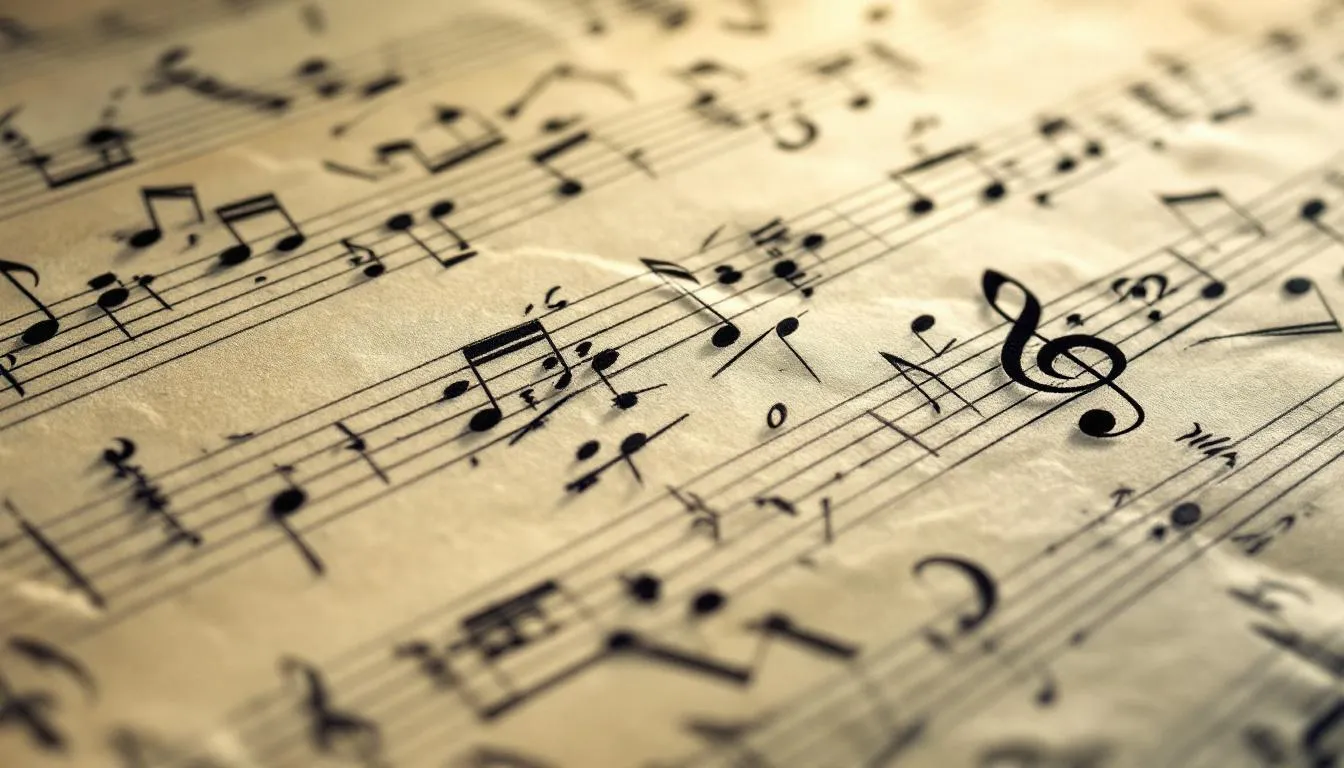
Sheet music is the universal language of musicians, where notes dance on a page to create beautiful melodies. These notes are carefully placed between lines and spaces on a staff, a system designed to make reading music intuitive and efficient. Notes are positioned between lines to enhance readability and organization, allowing musicians to quickly interpret and perform music.
Understanding the structure of sheet music is the key to unlocking the mysteries of this musical language.
What Is the Structure of Sheet Music?
Imagine a blank page that suddenly transforms into a symphony of lines, spaces, and dots. That’s the magic of sheet music! At the core of this system is the staff, five parallel lines serving as a musical roadmap. Each line and space represents a different pitch, and the arrangement of these notes on the staff guides musicians on what to play.
The five-line staff system is crucial because it provides a consistent framework for notating music. Think of it as a musical grid. Just like how a grid in a notebook keeps your handwriting organized, the staff lines help musicians quickly identify which notes to play. This is especially helpful when sight-reading and processing information swiftly.
Each note’s position on the staff determines its pitch. For instance, in the treble clef, the bottom line represents an E, while the top line is an F. The spaces between the lines have their own set of notes, such as the spaces in the treble clef spelling out “FACE” (F-A-C-E). This structured system allows musicians to learn new pieces quickly, associating note positions with corresponding pitches.
I remember my first piano lesson, where my teacher introduced me to the staff. It felt like deciphering a secret code! But soon, as I practiced, those lines and spaces became second nature. It’s like learning to read words in a book; once you get it, you can’t unsee it. For beginner pianists, the Hoffman Academy YouTube Channel offers fantastic, structured lessons.
Understanding this structure is just the beginning of unlocking the efficiency and speed with which musicians interpret music. For those looking to dive deeper into scales, chords, and music theory, tools like the Piano Companion app can be incredibly helpful.
How Does Note Positioning Aid Musicians?
Imagine trying to read a book where every word is a different color, size, and font. It would be chaotic and confusing. The positioning of notes on sheet music is akin to having a well-organized book, crucial for clarity and ease of reading. By placing notes between lines and spaces, musicians can quickly identify and play the correct pitch and rhythm without hesitation.
This organization is essential for visual grouping. Notes are strategically placed to indicate their relationships, making it easier to interpret melodies and harmonies. For example, if there’s a cluster of notes in one measure, you can quickly see if they’re meant to be played as a chord or in quick succession, like a musical sprint.
Moreover, sheet music with numerous notes, such as complex orchestral scores, can easily become cluttered. The use of lines and spaces prevents this mess, allowing musicians to navigate intricate compositions gracefully. It’s like a teacher color-coding different subjects in a lesson plan; organizing information visually makes chaos manageable. This is especially helpful when sight-reading and processing information swiftly. For those looking to improve their sight-reading skills, tools like SightReadingFactory can provide endless practice.
I recall playing a particularly challenging piece during a college recital. At first glance, the notes seemed like a swarm of bees! But thanks to the structured use of lines and spaces, I was able to dissect the piece and perform it with confidence.
This level of organization is not just a neat trick; it’s the backbone of musical notation. Next, let’s delve into the significance of these lines and spaces in making music notation the elegant system it is.
Why Are Lines and Spaces Important in Notation?
Lines and spaces in music notation are the DNA of sheet music, providing clarity and structure to every piece. Each line and space on the staff represents a distinct pitch, much like each rung on a ladder takes you to a different height. This differentiation is crucial for musicians to accurately play intended notes and rhythms.
Clefs play a vital role by defining the pitch range of the notes. The treble clef, often called the “G clef,” curls around the second line, designated as G, setting the stage for all other notes on the staff. Meanwhile, the bass clef, or “F clef,” centers around the fourth line, marking it as F. These clefs act as a map legend, guiding musicians through the musical landscape.
In the treble clef, the notes on the lines from bottom to top are E, G, B, D, and F, often remembered by the phrase “Every Good Boy Deserves Fudge.” Meanwhile, the spaces spell out FACE. On the bass clef, the lines read G, B, D, F, A, remembered as “Good Boys Deserve Fudge Always,” while the spaces are A, C, E, G, which some recall by “All Cows Eat Grass.”
As we move forward, it’s fascinating to see how different instruments interpret these same lines and spaces uniquely, each adding its own flavor to the symphony of sheet music.
How Do Different Instruments Use Sheet Music?
In the world of sheet music, it’s not a one-size-fits-all situation. Different instruments have unique relationships with the notes between the lines, much like how we all have our quirks and preferences.
For instance, if you play the flute, you’ll typically read music in the treble clef, where those “FACE” and “Every Good Boy Deserves Fudge” mnemonics come in handy. In contrast, if you’re a cellist, you’ll find yourself navigating the bass clef more often, where “All Cows Eat Grass” becomes the mantra. Similarly, guitarists often find comprehensive resources like JustinGuitar invaluable for learning their instrument’s specific notation and techniques. Each instrument has its own staff preferences, making the musical dialogue both diverse and fascinating.
Transposition is another intriguing aspect of sheet music that can perplex some musicians. Instruments like the trumpet or clarinet are transposing instruments, meaning the music they read is written in a different key than it sounds. This means that a note written as C on their sheet might actually sound as a B♭ or E♭. It’s like speaking a secret language where only the initiated can understand what’s truly being said!
I remember the first time I played a piece on the French horn, a notorious transposing instrument. My brain felt like it was doing gymnastics trying to match the notes on the page with the sounds coming out of the instrument. It was a rewarding challenge, much like solving a complex puzzle.
Moreover, instrument-specific notation can also include specialized symbols or techniques. For example, string players often encounter markings for different bowing techniques, such as staccato or legato, while pianists might see pedal markings indicating when to press or release the pedals. These notations are like little road signs, guiding each musician through the intricacies of their musical journey.
With this in mind, it’s intriguing to consider how these complexities have developed over time, shaping the sheet music we know today. As we journey further into this exploration, we’ll uncover the historical milestones that have led to modern musical notation—a story rich with evolution and adaptation.
What Historical Developments Led to Current Notation?
If you’ve ever wondered how those crisp, black notes came to elegantly dance on a page, you’re not alone. The evolution of musical notation is a journey that mirrors humanity’s quest for clarity and communication in music. Medieval monks painstakingly drew neumes—symbols indicating pitch direction—on parchment. These early attempts lacked precision but were a giant leap from oral tradition to visual representation.
Fast forward a few centuries, and we see Guido d’Arezzo, an Italian monk, introducing the four-line staff in the 11th century. This was a game-changer, giving musicians a reliable reference for pitch. It was like handing them a map for the first time. As time progressed, the staff grew to five lines, and the placement of notes between these lines took the form we recognize today.
Key advancements in notation came during the Renaissance and Baroque periods when composers began experimenting with rhythm and harmony. This led to more complex scores and the need for a more detailed system. The introduction of clef symbols helped specify pitch ranges, much like how modern street signs guide us through a city.
In recent times, technology has revolutionized music notation. Software like Finale and Sibelius allows composers to create and share music globally with precision and ease. Additionally, resources like IMSLP (International Music Score Library Project) provide free access to a vast collection of public domain scores. This digital era of notation is akin to having a virtual orchestra at your fingertips, making the dissemination of music faster and more efficient than ever.
Exploring the past reveals how each innovation has contributed to the rich tapestry of musical expression we enjoy today. As we look forward, consider how these historical developments continue to shape how we interact with music and its notation.
Key Takeaways
- Notes between lines improve readability, helping musicians quickly interpret music.
- The five-line staff system is crucial for distinguishing pitches and rhythms efficiently.
- Historical innovations, from medieval neumes to digital notation, have refined note positioning.
Remember, mastering sheet music is a journey of patience and practice. Dive into your next piece with newfound clarity and appreciation for this intricate musical language!