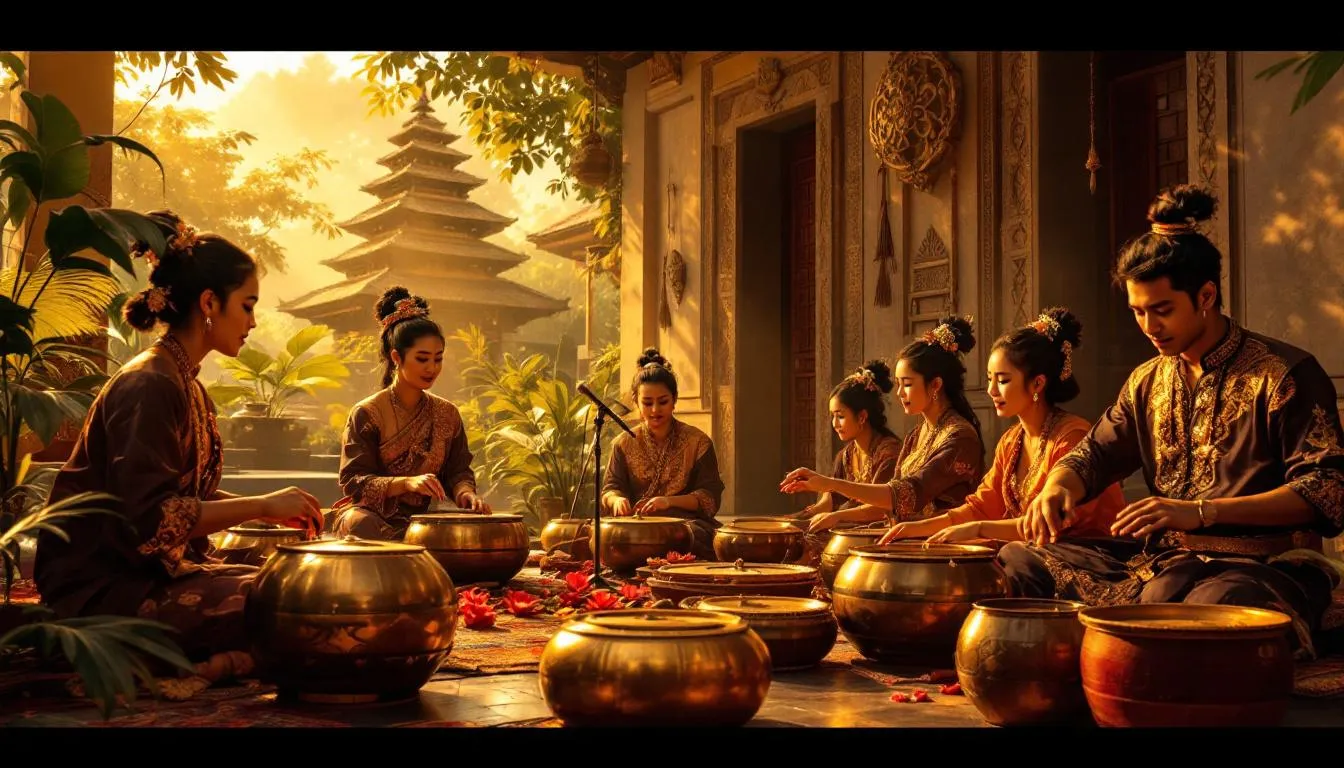
This blog post delves into the mesmerizing world of Gamelan music, a traditional Indonesian ensemble known for its distinctive sounds and cultural significance.
Quick Answer
Gamelan music is a mesmerizing traditional ensemble from Indonesia, particularly flourishing in Java and Bali. Its tonal landscape captivates with unconventional tuning systems, diverse scales, and a lush, percussive sound that distinguishes it from Western music’s structured norms. Gamelan’s uniqueness lies in its intricate layers of rhythm and harmony, creating an immersive and enchanting auditory experience. Delving deeper into its roots reveals the cultural influences that have shaped this extraordinary musical form.
What Are the Origins of Gamelan Music?
Before the bustle of modern life, the Indonesian islands were rich with traditions and cultural practices. Gamelan music emerged from this vibrant backdrop, deeply rooted in the ancient history of Java and Bali. Legend tells of a Javanese god, Sang Hyang Guru, who created the first gong to summon other gods. This divine inspiration led to the development of the gamelan ensemble, featuring a wide range of metallic percussion instruments that together create a soundscape as colorful as a tropical sunset.
The cultural significance of gamelan music in Indonesian society is profound. It is more than entertainment; it’s woven into the fabric of community life. In Java and Bali, gamelan music accompanies various cultural rituals, from temple ceremonies to wayang kulit (shadow puppet) performances. I recall attending a wedding in Bali where the gamelan orchestra played, making the music a living, breathing part of the celebration, guiding the day’s emotions.
Gamelan is also a communal activity, bringing together musicians of all ages and backgrounds. Each player contributes to a collective sound, fostering unity and shared experience. I often emphasize this aspect to my students, drawing parallels to ensemble playing in Western music while highlighting gamelan’s unique sense of community and spirituality.
With such rich history and cultural significance, gamelan music offers a fascinating contrast to Western musical traditions. As we explore these differences, we’ll uncover the distinctive characteristics that make each musical form special.
How Does Gamelan Differ from Western Music?
Gamelan and Western music are like two different languages, each with unique grammar and vocabulary. One of the most striking differences is their Gamelan tuning systems. Gamelan music uses two main types: slendro and pelog. Slendro is a five-note scale dividing the octave into roughly equal intervals, while pelog is a seven-note scale with uneven spacing. This creates a sound that’s haunting and enchanting, inviting listeners into a mysterious world.
Comparison of Gamelan and Western Tuning Systems
In terms of melodic and rhythmic structures, gamelan music departs from the linear progression often found in Western compositions. Instead of a single melody leading the way, gamelan employs a layered approach where multiple melodies intertwine, producing a rich tapestry of sound with rhythms and harmonies flowing in cycles. It’s like watching a river with countless branches, each contributing to the overall current.
Gamelan’s use of non-Western scales enhances its otherworldly feel. The scales are not just different in terms of notes but also in how they interact and evoke emotion. In gamelan, scales are a living expression of cultural identity and tradition. If you’re exploring different scales and music theory concepts, even those in Piano Companion, a music theory app for songwriters, producers, teachers, and students, you’ll appreciate how understanding these structures can deepen your musical insight. It’s a flexible piano chord and scale dictionary with user libraries, reverse mode, circle of fifths, and a chord progression builder with common patterns. I remember the first time I played a gamelan piece; it felt like stepping into a different universe where time and space were defined by the music itself.
Understanding Western music theory fundamentals can provide a clear contrast to these unique Gamelan structures, helping to highlight their distinct characteristics.
Understanding the instruments that bring gamelan to life further deepens our appreciation for this unique tonal landscape.
What Instruments Are Used in Gamelan?
Entering a gamelan performance is like stepping into a vibrant tapestry of sound, where each instrument plays a crucial role in weaving the intricate musical fabric. At the heart of this ensemble are the metallophones—bronze or iron bars struck with mallets. Instruments like the saron and gender produce the shimmering, resonant tones defining gamelan music.
Gongs, such as the massive gong ageng, serve as the ensemble’s anchor, punctuating the music with deep, sonorous notes that vibrate through your being. The unique sound of these instruments is deeply tied to their physical properties and the harmonics and overtones they produce. I remember the first time I felt the gong ageng‘s reverberation; it was as if the ground beneath me was gently humming along with the music.
Drums, or kendhang, maintain rhythm and tempo, guiding the performance’s flow. The drum player, or pengendang, acts almost like a conductor, subtly influencing the dynamics and pace.
Other instruments like the bonang, a set of small gongs, add layers of melody and rhythm, while the rebab, a two-stringed fiddle, lends a touch of haunting lyricism. Each instrument’s construction reflects its unique purpose: handcrafted from specific materials like bronze or iron, designed to produce a distinct sound that contributes to gamelan’s rich auditory landscape.
As we delve deeper into the essence of gamelan, it’s easy to understand why this music feels so enveloping.
Why Is Gamelan Music Perceived as Immersive?
Listening to gamelan music is like diving into a sonic ocean, where waves of sound wash over you, each note a droplet in a vast, shimmering sea. This immersion stems from gamelan’s layered textures and cyclical patterns. The auditory experience is calming yet invigorating, inviting exploration of its intricate harmonies.
A key element contributing to this immersive quality is the role of repetition and variation within gamelan compositions. Unlike Western music, which often builds towards a climax, gamelan revolves around repeating themes that subtly evolve over time, creating a hypnotic effect. It’s like watching a kaleidoscope, where each turn reveals a slightly different pattern, yet the colors and shapes remain familiar.
The music’s cyclical nature mirrors life’s cycles, resonating with listeners on a profound level. My own experience attending a gamelan performance felt like participating in a communal meditation, where the music’s ebb and flow guided our collective consciousness. There’s something transcendent about being part of this shared auditory journey, as if the music itself is a bridge to another realm.
This sense of immersion and connection has not only captivated audiences for centuries but also inspired musicians worldwide.
How Does Gamelan Music Influence Modern Music?
Gamelan’s enchanting tonal landscape and cyclical structures have quietly seeped into modern music, influencing artists across genres. One notable example is American composer Steve Reich, who in the 1970s explored gamelan’s rhythmic complexities. His minimalist compositions, like “Music for 18 Musicians,” echo gamelan’s interlocking patterns and pulsating dynamics.
British composer Benjamin Britten also drew inspiration from gamelan after attending a performance during a trip to Bali. He incorporated gamelan-like textures and scales into works like “The Prince of the Pagodas,” where the shimmering, metallic timbres of gamelan add an exotic flair to his Western classical forms.
Cross-cultural collaborations have flourished, with gamelan ensembles teaming up with artists from diverse backgrounds. For example, the collaboration between Balinese gamelan group Gamelan Sekar Jaya and the Kronos Quartet created a fresh blend of traditional and contemporary sounds. These collaborations underscore gamelan’s adaptability, weaving its unique qualities into a rich tapestry of global musical expression.
The fusion of gamelan with modern music not only showcases its timeless appeal but also highlights how music can transcend boundaries, fostering cultural dialogues. Reflecting on gamelan’s journey from ancient temples to contemporary stages, it’s clear its influence continues to resonate, encouraging exploration of music’s endless possibilities.
Key Takeaways
- Gamelan music presents a unique auditory journey with its distinct slendro and pelog scales, offering a fresh perspective on musical tuning.
- The ensemble’s rich percussive sound and layered compositions create an immersive experience that captivates listeners worldwide.
- Gamelan’s influence has permeated global music, inspiring genres and artists beyond its traditional roots.
Embrace the enchanting world of gamelan by exploring its rhythms and harmonies. Whether you’re a musician or a curious listener, let this vibrant tradition inspire your musical exploration!