Quick Answer
In musical notation, clefs are vital symbols that help musicians identify pitches on a staff. Among these, the F clef, or bass clef, is key for indicating notes below middle C, such as those played by the left hand on the piano or by bass instruments. The F clef is indispensable for reading and performing lower pitches, guiding musicians and composers alike. Understanding its role deepens appreciation for how music is structured and performed.
What Is the F Clef?
The F clef, often called the bass clef, serves as a compass for musicians navigating the lower ranges of musical notation. Its primary function is to anchor the note F below middle C on the staff, setting the stage for deep, resonant tones. Think of the F clef as a road map for anyone playing instruments like the bassoon, cello, or the piano’s left hand. It ensures you don’t hit an E when you meant to play an F.
The F clef situates itself with purpose: it wraps around the fourth line of the staff, with two dots flanking it. This line marks the F note, clarifying for musicians which notes are which.
When I taught my first beginner piano class, I remember the lightbulb moment when students realized this simple symbol was their key to understanding the lower half of the keyboard, unlocking a musical mystery.
This clarity was not always the case. The journey of how the F clef became a staple in musical notation is marked by evolution and adaptation.
How Did the F Clef Originate?
Before the F clef became the guide it is today, musical notation was like the Wild West. Musicians once relied on neumatic notations—symbols that vaguely indicated melodic contour without specifying exact pitches. It was akin to baking with a recipe that says “add some flour” and “stir for a while”—frustrating for musicians.
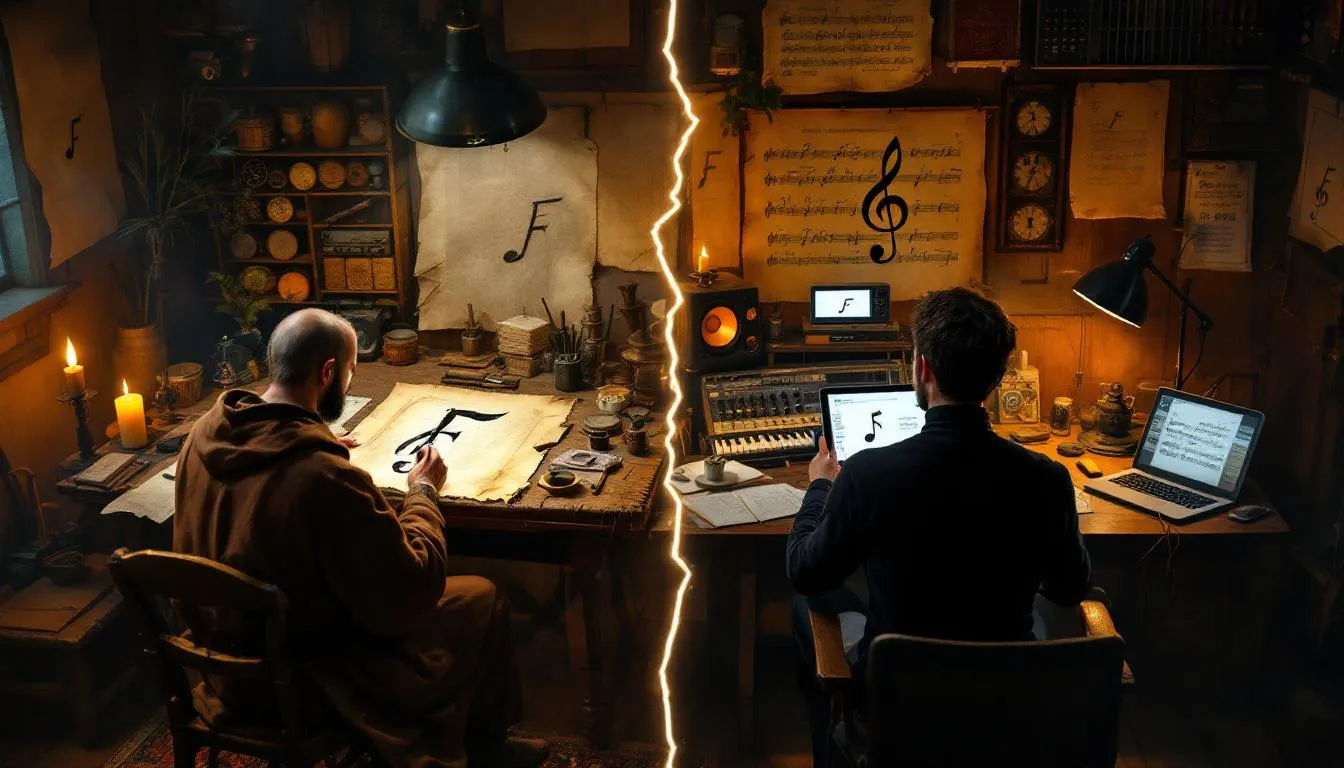
As music evolved, so did the need for precision. Enter the medieval monks, pioneers in this transformation. They began placing letters at the start of musical lines to indicate pitch. The letter F, crucial for deep bass notes, gradually morphed into a stylized symbol. This was the humble beginning of the F clef.
The evolution of musical notation was like upgrading from a basic map to a GPS. With each tweak, musicians gained clarity, allowing for the complexity of compositions we enjoy today. It’s fascinating that a simple letter became an indispensable tool in music.
The story of the F clef doesn’t end here—its variations continue to intrigue musicians and scholars alike. Let’s explore its different forms and roles in musical history.
What Are the Variations of the F Clef?
While the F clef primarily marks the bass line, it adapts to fit different musical contexts, displaying chameleon-like versatility.
Different Forms and Adaptations:
- Standard Bass Clef: The most common form, resembling a stylized “F” with two dots, is used widely in scores.
- Baritone Clef: This variation places the F clef on the third line for baritone vocal parts, giving singers their personalized roadmap.
- Sub-bass Clef: Used in orchestral scores for instruments like the contrabassoon, it sits below the bass clef.
Usage in Different Musical Contexts:
In choral music, the F clef adapts to various vocal ranges. For instance, the baritone clef finds its place in mixed choir arrangements. In orchestral scores, the bass clef is a staple for instruments like the tuba, bassoon, and double bass, creating harmony in symphonies.
I recall a choral rehearsal where the conductor adeptly switched between clefs to demonstrate vocal parts, like a master chef blending spices to create harmony.
Understanding these variations enriches our appreciation of the F clef and highlights its versatility. This versatility extends beyond classical music, influencing modern compositions and contemporary settings.
How Is the F Clef Used in Popular Culture?
In today’s world, where memes and internet culture reign supreme, the F clef has found its way into the limelight. This musical symbol, originally for serious composition, is now a staple in meme videos and humorous posts online. One favorite example is a meme showing a musician fainting at the sight of multiple clefs, dramatically reacting to the F clef as if to say, “Not again!” It reminds us that even a clef can become a relatable joke for musicians worldwide.
Beyond memes, the F clef serves as a symbolic representation in creative adaptations. I’ve seen it in tattoos as a nod to one’s passion for music, with the two dots cleverly integrated into musical notes or hearts. It’s a way for musicians to carry their craft with them, both literally and figuratively.
These humorous and symbolic uses highlight the F clef’s versatility and enduring presence in both classical music and contemporary culture. It’s a testament to how deeply embedded music is in our lives, influencing not only the sounds we create but also the ways we express ourselves beyond the notes on a page.
Why Is the F Clef Important in Music Theory?
Understanding the F clef unlocks a musical treasure chest. It’s crucial for grasping musical expression, especially in the lower sonic spectrum. This clef helps musicians comprehend the vast landscape of notes, providing the foundation for bass instruments and voices that add depth and richness to music.
In my early teaching days, I compared the F clef to the root system of a mighty tree. Just as roots provide stability, the F clef anchors compositions by giving life to profound bass notes. Imagine listening to an orchestra without the rumble of the double bass or the hum of the cello—it would feel incomplete.
The F clef is indispensable for bass instruments like the tuba, trombone, and electric bass guitar. It guides musicians to navigate their parts, ensuring their contributions blend seamlessly with the ensemble. Whether it’s the deep notes of a jazz bassist or rich harmonies in a choral arrangement, the F clef ensures each note hits perfectly.
In vocal music, the F clef is vital for bass and baritone voices, providing clarity and precision for powerful and nuanced performances. It’s like giving vocalists the perfect map, ensuring they hit every note with confidence.
How Has the F Clef Influenced Modern Music Notation?
The F clef’s influence on modern music notation is profound, shaping composers’ and musicians’ interactions with music. In contemporary compositions, the F clef guides deep, resonant tones that add richness to any piece. Composers rely on it for balanced arrangements, ensuring bass instruments provide a sturdy foundation. Just like a well-balanced meal needs its carbs and proteins, a composition thrives on harmony between high and low notes.
In my teaching experience, I’ve seen students transform their compositions by effectively using the F clef. It’s like giving them the secret ingredient to elevate their musical recipes, allowing their pieces to resonate with depth and emotion.
Additionally, the F clef’s integration into digital music software has revolutionized music creation and sharing. Software like Sibelius and Finale incorporate the F clef, making it accessible for composers to craft intricate bass lines. This digital integration allows for instant playback, giving composers immediate feedback on their bass parts. For those looking to deepen their understanding of music theory and explore chords and scales, a tool like Piano Companion can be invaluable for songwriters, producers, teachers, and students. I often joke with students that it’s like having a virtual orchestra at their fingertips—one that doesn’t complain about frequent key changes!
With the F clef’s enduring presence in traditional and digital formats, its influence on music continues to grow. Let’s distill these insights into practical takeaways.
Key Takeaways
- The F clef, or bass clef, is essential for reading and performing lower pitches.
- Its evolution from a simple letter to a stylized symbol highlights music notation’s development.
- Mastery of the F clef enhances a musician’s ability to navigate bass lines in various contexts.
- Understanding the F clef is crucial for both classical and contemporary compositions.
- Embrace the F clef as a tool to deepen musical knowledge and expression, guiding exploration of the rich, resonant world of lower musical registers.