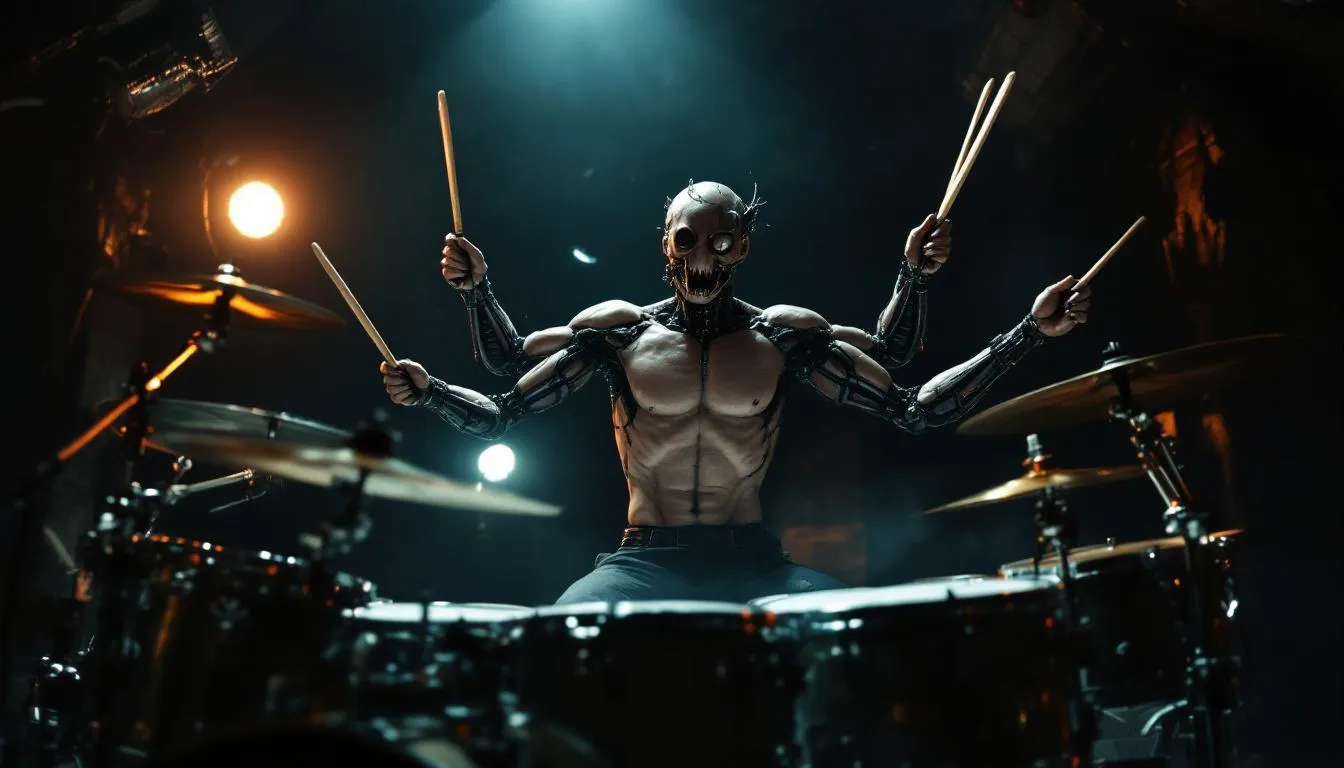
Complex polyrhythms are intricate musical patterns where two or more contrasting rhythms are played simultaneously, crafting a tapestry of sound that can both challenge and delight listeners. Musicians navigate these rhythms by balancing precision with a touch of approximation, much like a tightrope walker maintaining equilibrium.
While precision is vital for capturing the intended complexity of polyrhythms, musicians often employ a degree of flexibility to adapt and maintain fluidity in performance.
These rhythmic wonders may seem daunting, but understanding their essence can unlock a new dimension of musical expression.
What Are Complex Polyrhythms?
Picture yourself at a concert, captivated by a mesmerizing drum pattern that weaves in and out of time, creating a rich, layered soundscape. That’s the magic of complex polyrhythms. At their core, polyrhythms involve playing multiple rhythms simultaneously, often with different time signatures. It’s like patting your head and rubbing your belly simultaneously—only more musical!
These structures can be as simple as a 3:2 pattern, where one musician plays three beats for every two beats of another. They can also evolve into more intricate forms, like a 7:4 polyrhythm, resembling a dance between a waltz and a march. This complexity creates a sonic texture that’s both challenging and exciting for listeners and performers.
Polyrhythms are the heartbeat of Afro-Cuban music, the pulse of progressive rock, and the texture in modern classical compositions. A fantastic example is Steve Reich’s “Clapping Music,” where two performers gradually shift a simple rhythm against itself, creating an intricate sound tapestry. Another example is the drumming in bands like Tool, where the drummer’s feet and hands inhabit different worlds yet come together in a unified musical expression.
I recall teaching a student fascinated by African drumming polyrhythms. We spent weeks exploring the 6:4 rhythm, watching the transformation from frustration to a joyful dance of the hands. This is the beauty of polyrhythms: they push boundaries and open up new worlds of musical expression.
Learning these rhythms may seem daunting, but with dedicated practice and the right approach, anyone can unlock their secrets.
How Do Musicians Learn Complex Polyrhythms?
Learning complex polyrhythms is like embarking on a musical treasure hunt, where each step brings you closer to rhythmic mastery. Musicians often begin by breaking down intricate patterns into manageable pieces. Like solving a jigsaw puzzle, they start with simpler rhythms and gradually layer them to build complexity.
One effective technique is the “count and clap” method. By clapping one rhythm while counting another, musicians internalize the patterns before attempting them on their instruments. Practicing a 5:3 polyrhythm, for instance, might involve counting “1-2-3-4-5” while clapping every third count. This helps in understanding how the rhythms align and interlock.
Another key strategy is mental mapping. Musicians often visualize the rhythms in their minds, similar to how a conductor visualizes a symphony. This mental rehearsal aids in grasping the feel and flow of the polyrhythm, making the physical execution more intuitive.
Practice is the cornerstone of mastering polyrhythms. Consistent, focused practice helps build muscle memory and enhances coordination. As a teacher, I’ve seen students transform from hesitant novices to confident performers through regular practice. I remember one student struggling with a 4:3 rhythm; we tackled it step by step, and over time, their hesitant taps turned into a seamless flow of beats. For those looking to deepen their understanding of music theory concepts beyond rhythm, a tool like Piano Companion can be invaluable. This music theory app helps songwriters, producers, teachers, and students navigate complex piano chords and scales, offering a flexible dictionary, reverse mode, and a chord progression builder.
Learning complex polyrhythms isn’t just about precision—it’s about feeling the rhythm in your bones. This brings us to an intriguing aspect of rhythm: how musicians balance precision with approximation in their performances.
Do Musicians Strive for Precision or Use Approximation?
Precision in playing complex polyrhythms is like the backbone of a well-crafted symphony. Musicians strive for this accuracy to ensure each interlocking rhythm fits the musical puzzle perfectly. Like a watchmaker meticulously aligning gears, precision maintains the integrity of the composition, ensuring every beat falls exactly where it should.
However, we’re human, not metronomes. There are moments when a touch of approximation becomes not just practical but essential. Performing live is dynamic—sound levels fluctuate, adrenaline pumps, and fellow musicians might introduce unexpected twists. In these instances, musicians might embrace approximation, allowing them to adapt to the moment’s vibe and respond intuitively to other performers.
I’ve witnessed this firsthand during jam sessions, where the music’s beauty lies in its spontaneity. I recall a gig with a tricky 9:8 rhythm; as the band found its groove, slight approximations allowed us to maintain cohesion and engage the audience, even if it meant deviating slightly from rehearsed precision.
This balance between precision and approximation is not just a skill; it’s an art. Musicians learn to navigate this fine line, ensuring their performance resonates with both technical brilliance and emotional authenticity.
As we delve deeper into the world of rhythm, we encounter the intriguing question of how far human perception can stretch in music.
What Are the Limits of Human Perception in Music?
Music stretches the boundaries of human perception, pushing us into uncharted auditory territories. Understanding complex polyrhythms challenges and expands our cognitive limits. Imagine trying to follow multiple conversations at once—your brain works overtime to process and comprehend it all. Similarly, in music, our brains juggle different rhythms, leading to a fascinating interplay between what we hear and what we can understand.
Studies show that while our brains are adept at recognizing patterns, there’s a threshold to the complexity we can comfortably process. This threshold varies among individuals, with factors like musical training and experience playing significant roles. Trained musicians often have more developed auditory skills, enabling them to perceive and perform polyrhythms that might bewilder the average listener.
Theories in cognitive science suggest our perception of rhythm isn’t just passive reception but active pattern construction. Our brains simplify complex rhythms into manageable forms, often grouping notes into perceptual chunks. This can result in an intriguing phenomenon where our perception of a rhythm may differ from its actual execution.
In my teaching experience, I’ve noticed students initially struggle with grasping the full complexity of polyrhythms. Yet, with practice, they begin to “feel” the rhythm more intuitively, suggesting our perception can indeed expand with exposure and effort.
Our journey into rhythm doesn’t stop here. Just as our perception adapts, we must consider whether achieving perfection in polyrhythms is within reach or an ever-evolving pursuit.
Is Perfection in Polyrhythm Attainable?
Perfection in polyrhythms is like chasing a mythical pot of gold at the end of a rainbow—an enticing yet elusive goal. Musicians often strive for flawless execution where every beat clicks into place like a Swiss watch. This pursuit of perfection is driven by the desire to honor the music’s complexity and convey its intricate beauty. When I hear a perfectly executed polyrhythm, it feels like witnessing a masterful dance, with every step deliberate and in harmony.
Yet, there’s another perspective suggesting absolute perfection might not only be unattainable but unnecessary. Music, after all, is a living art form. It breathes, evolves, and sometimes, its quirks and imperfections make a performance memorable. Performing with a jazz ensemble, there were moments when the music transcended technical precision. It was the slight deviations, the human touch, that brought the piece to life and kept the audience engaged.
Insights from professional musicians and educators reveal diverse perspectives. Some argue perfection is a moving target, constantly shifting with new interpretations and styles. Others embrace imperfections as opportunities for expression and creativity. As one seasoned drummer told me, “It’s not about playing it perfectly; it’s about playing it right for the moment.” This sentiment underscores the idea that while technical mastery is important, the essence of music often lies in its emotional impact and connection.
Reflecting on the balance between striving for perfection and embracing imperfection in music, it’s clear the journey is as important as the destination.
Key Takeaways
- Precision and Approximation: Master complex polyrhythms by balancing accuracy with flexibility, adapting to the musical environment.
- Techniques Matter: Use methods like “count and clap” and mental mapping to internalize complex rhythms.
- Perceptual Limits: Recognize individual cognitive thresholds; experience and training can expand these boundaries.
- Set Realistic Goals: Aim for improvement and expression, not just perfection, in your musical endeavors.
Embrace the journey of polyrhythms—where each practice session is a step toward both technical mastery and personal expression. 🎶